


18 November 2025. In the middle of the working day.
X, ChatGPT, Facebook, WhatsApp, Zoom, PayPal… suddenly everything comes to a standstill; much of the digital world grinds to a halt.
A single outage at a single provider – Cloudflare – brought much of the internet to a standstill. Two weeks later, on 5 December, the same scenario unfolded.
For many, it was a nuisance. For companies that have built their entire internal communication on a11> such services based was, it was a wake-up call.
The silent risk, the one nobody likes to talk about
Much of our digital infrastructure relies on a handful of providers, most of whom are American. This is no secret – but it is also not a topic that is regularly discussed in strategy meetings. As long as everything is running smoothly, nobody gives it a second thought.
Until suddenly it stops working.
And then what was previously invisible becomes clear: just how many processes, communication channels and critical pieces of information actually depend on a single infrastructure. Email down. Intranet down. File server down. Video conferencing down. And suddenly the question arises: how on earth do I reach my team now?
Outages are only on the one side. The other are targeted attacks.
Figures that should give us pause for thought
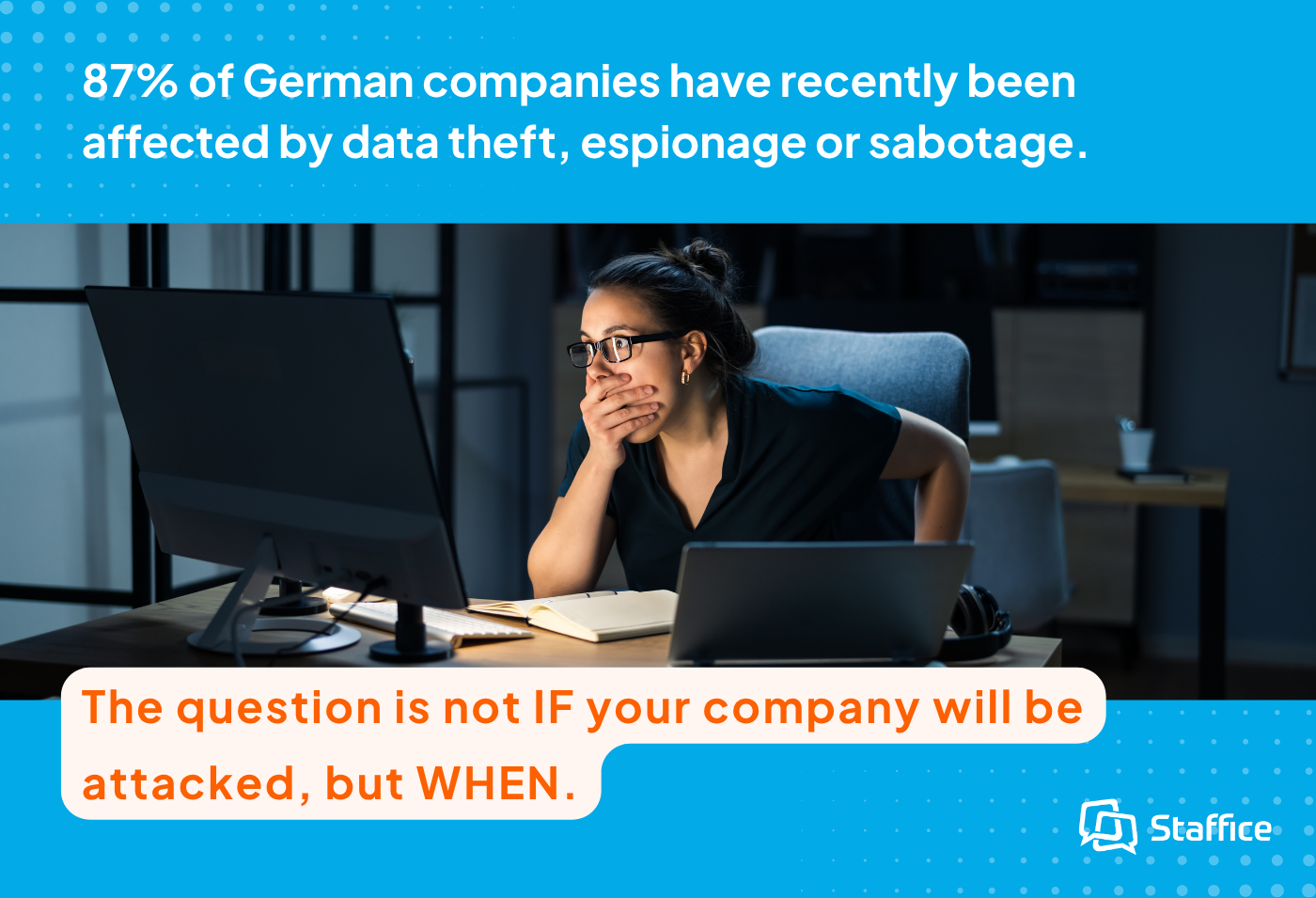
87% of German companies have recently been affected by data theft, espionage or sabotage. According to Bitkom, the damage caused by cyberattacks in Germany alone amounts to 202 billion euros – part of a total loss of 289 billion euros in 2025.
And yet a misconception persists: “We are too small to be of interest.”
It is wrong. Proven to be wrong.
Attackers do not choose their targets based on prominence, but on vulnerability. Small and medium-sized enterprises have long been just as much in the spotlight as large corporations – often even more so, because their systems are less well protected. The question today is no longer whether a company will be attacked. It is: when.
What this has to do with internal communication
Imagine your systems are encrypted by ransomware. The company network has to be taken offline. Email is down. The intranet is down. The file server is down.
How do you now communicate with your staff?
Who informs employees about what is happening? Who coordinates the next steps? Where are the contingency plans – and can they still be accessed?
It is at precisely this moment that it becomes clear whether a company will remain capable of acting or become paralysed. And it is at precisely this moment that it becomes clear whether internal communication has been treated as a strategic factor – or merely as a convenience for day-to-day operations.
Staffice as a digital emergency exit
This is where one aspect of Staffice comes into play that we actually don’t talk about nearly often enough:
Staffice runs independently of your internal IT systems. As a standalone instance hosted in Europe, the app isn’t linked to your company network, your email infrastructure or external US services. If the rest of your IT systems are down, Staffice keeps running.
In practical terms, this means your team remains reachable and can coordinate. Important documents, contingency plans and critical processes that you’ve stored in Staffice remain available. The company’s connectivity does not break down.
During the Cloudflare outages in November and December 2025, we experienced exactly that: other services came to a standstill. Staffice kept running.
A well-maintained Staffice instance is not just your everyday communication channel. It is your digital emergency exit.
Safety must be established before an emergency arises
Staffice’s potential as a safety net can only be fully realised if the basics are in place. Emergency contacts must be stored in the system. Critical processes and documents must be hosted within the app – not just on a file server that cannot be accessed in an emergency.
That sounds like a lot of work. But above all, it is a question of priority. Because if you wait until the crisis hits, you end up setting up something that could have been put in place calmly beforehand.
How resilient is your business if the technology really does fail?
👉 Book a consultation now and set up Staffice as your digital fallback solution.